Showing posts with label Basic Knowledge. Show all posts

Thursday, July 5, 2012

Lotuschef in Conversation - Leave TBS, in search of True Buddha

Terjemahan Indonesia: Lotuschef Bercakap-cakap – Meninggalkan Aliran Satya Buddha untuk Mencari Buddha yang Sejati 

Green in True Buddha Sutra signifies thousands upon thousands of light treasures.
Blossoming forth infinitely from the elixir pot are Dharma Treasures spanning the entire Universe.

Lotus ST:  {After all these years inTrueBuddhaSchool, I discovered that the only way to see True Buddha is to leaveTrueBuddhaSchool. If stay inTrueBuddhaSchool, only can see TrueBuddhaSchool, cannot see True Buddha. Upon Seeing True Buddha, there is no existing problem leaving or not leaving TrueBuddhaSchool... Amazing.

Although I left, I still cultivate once a day, with the most revered Root Guru, Living Buddha Lian Sheng always sitting atop my head.}

In actual fact, this cultivate once a day, – in itself contains millions of problems.

Simply speaking, Grand master said: Respects Guru,  Treasures Dharma, Diligently Cultivate, coupled with Visualization – Mudra – Mantra is sufficient.

However, most can not adhere to these!  Having a look at the different grades of students passing under the empowerment transmission banners, one will easily recognize the problem!

Most are busily making sure that their hands or the items they are carrying in which they think very important to get blessing, touch the Empowerment Transmission Banners!

When I tried to tell them to keep all these items and concentrate on Visualization Mudra Mantra when passing under the Empowerment Transmission Banners, they said: Shangshi taught me this way! They gave me a look as if I am crazy to tell them otherwise!

Hahaha! Really, why not scrutinize the process and see that even Dharma Propagators are no exception!


{With the most revered Root Guru, Living Buddha Lian Sheng always sitting atop my head} – Dear Lotus ST, this is what Guru wanted me to tell you earlier on, Affinity! Hehehe! Can’t find the right opportunity to tell you.

You change to – {with the most revered Root Guru, Living Buddha Lian Sheng always sitting within my Heart Chakra!}


Guru said previously : To let Buddha resides within your Heart Chakra!

Buddhas are scared of the cold? No!
Employing Buddha to find Buddha!
Buddha to lead Buddha!
With Illusory, cultivate and transform to REALITY!


With Buddha in your Heart Chakra, as long as you chant Guru’s mantra, there is immense light emitted from your Heart Chakra radiating all over to share with all sentient beings!

This is Dharma Charity of Bodhicitta!

We have arrived at the end of today’s journey, had fun?
See you next time!


Amituofo
Pure Karma
Lama Lotuschef
True Buddha School

Wednesday, July 4, 2012

Lotuschef in Conversation - Leave TBS


Terjemahan Indonesia: Lotuschef Bercakap-cakap – Meninggalkan Aliran Satya Buddha


ST:  [After all these years in True Buddha School, I discovered that the only way to see True Buddha is to leave True Buddha School. If stay in True Buddha School, only can see True Buddha School, cannot see True Buddha. Upon Seeing True Buddha, there is no existing problem leaving or not leaving True Buddha School... Amazing.]

[The reason for those that left True Buddha School is they can't see True Buddha, however, for me, I am leaving True Buddha School because I want to see True Buddha. The difference lies within this.]

[Although I left, I still cultivate once a day, with the most revered Root Guru, Living Buddha Lian Sheng always sitting atop my head.

{The Only Choice} This is for me only .... others might not be the same. Like a certain prescription is good for me but might be poisonous to others... this is my meaning..]

---

Lotuschef: Hi ST, Guru ever tell me:  [Leave True Buddha School.]

Hahaha! I found out it means leave the traditions or hear-say like VM said...... or standard cultivation techniques behind.

Find my own!

You have joined me in cultivation before; think I fulfilled Guru's instructions?

Cheers. All the best to your leaving TBS.

I hope my angle is of use to you.

Congrats again, to the new family member and blessing to all!

Om Guru Lian Sheng Siddhi Hom!

---

Dear all, in Guru's recent speeches, he said if in doubt ask me or those masters in the know. It means that not all masters knows or can impart certain knowledge to you, because they don't know anything about certain topics or techniques too.

Look at this statement objectively, Guru means don't attached qualities to Forms and be Fixated about these Forms having what you think or others say they should have or be.

Believe or not, Guru does teaches anyone with sincere mindset to learn and share with all beings.

Almost 2 years ago, while meditating, Guru said to me: Leave True Buddha School.

I said: Why? I am still learning and you know I am still very new to TBS.

Guru just smiled.

However, with his infinite wisdom and patience, he guided me away from Tradition, Hear-say, Dos and Don'ts, This and that master said..... ; ...

Therefore I said I only listen to Guru and no one else! :)

If I follow blindly and cultivate the same way as most, I can't imagine what I will be doing today!


Like ST, he said his only way to see True Buddha is to leave True Buddha School. He still maintain cultivation daily with Guru atop his crown!

He is seeking the  True Buddha which is  his own Buddha Nature!

Therefore he said, to him it is the only way! 

In my case, I saw Guru, who is a True Buddha; telling me to leave True Buddha School!

Hahaha! Had Fun?

Happy Cultivating!


Amituofo
Pure Karma
Lama Lotuschef
True Buddha School

Monday, May 28, 2012

Discriminating Tantrayana?

Dear Fa Shi,


I want to know your thought on this video.


Reply:

Hahaha!


Dear all, this is my humble opinion only. Readers may choose to differ.

Om Guru Lian Sheng Siddhi Hom!


Please watch and listen carefully to the video above and you will benefit tremendously.


The Venerable brought out the essence of Tantrayana in his speech.

It is Buddha's solution to merge the traditional practices with Dharma to achieve Great Harmony!


He states that it is stipulated in the scripture that one needs to study Mahayana teachings for at least 10 years, in order to understand and start to practice Tantrayana.


He liken it to a student having attained a Master Degree and then can proceed to study for higher Degree to be a Professor.

As per his Guru, Tantrayana is not for anyone, just because they want to learn.


He touches on Anu Yoga, the Yab Yum practice. He is correct in saying that if one has not reach full renunciation, the practice is obscene and will land one in Hell.


All in, he kind of dispelled the Discrimination of Tantrayana and the myth of Yab Yam practice.


I do agree with him on learning Mahayana's teachings as Foundation. I find that most Tantrayana students of all sectors like Red; White; Yellow; Flower; True Buddha School; .... have no basic concepts and just want to cultivate fast to acquire "powers" which sentient beings adhered to Tantrayana.


Hahaha!

From now on, I sincerely wish that all study and practice the 4 Noble Truths and the 8 Fold Path as a foundation. Please check out the Back to Basics series that I shared or search for them from online & or other sources familiar to you.


Remember the recent 9-stages of cultivation I shared in this blog. Mahayana is actually at level 3 and the Ultimate is level 9 - Ati Yoga.


However, bear in mind that there are those that are reincarnation of Yogi and able to recollect or "draw back" upon what they have cultivated and able to be a little faster in moving up the cultivation ladder.


Open Mindset of living Harmoniously with all and also sharing One's cultivation achievements with all as well.


Let us all be crazily happy!


:)


Amituofo

Pure Karma

Lama Lotuschef

True Buddha School


Sunday, May 27, 2012

Saran-saran Guru Padmasambhava

Ditulis oleh Lotuschef – 4 Mei 2012
Diterjemahkan oleh Lotus Nino
Sumber: Padmasambhava’s Advice


[caption id="attachment_6810" align="aligncenter" width="293" caption="Guru Rinpoche Padmasambhava"][/caption]

Berikut adalah ekstrak dari buku yang berjudul “ADVICE FROM THE LOTUS BORN” (Saran-saran dari Ia yang terlahir dari teratai).

"Jangan membual tentang suatu pandangan yang kamu belum realisasikan! Karena pandangan itu sendiri kosong akan pengamatan, Inti dari Pikiran adalah hamparan dari Kekosongan yang Agung.


Karena Meditasi dilakukan tanpa Bermeditasi, biarkanlah pengalaman pribadimu Terlepas dari Kemelekatan.


Karena Tindakan dilakukan tanpa Bertindak, ia adalah Sifat Alami yang Tidak dibuat-buat.


Karena Keberhasilan adalah tidak Meninggalkan (melepas) ataupun Mendapatkan, ia adalah Dharmakaya Kebahagiaan Tertinggi.


Itulah Empat saran dari dalam lubuk hatiku.


Bila kamu menentangnya, maka kamu akan gagal menemukan Sifat Sejati Ati Yoga."


Teman-teman pembaca yang terkasih,

Bukankah itu hal yang Guru sering bagikan kepada kita semua?

Hanya sekedar 4 saran dari Hati Guru Rinpoche, tapi butuh waktu yang lama bagi kita untuk memahami dan melatihnya dengan benar.

Guru kita berkata bahwa kita hanya boleh memberikan opini mengenai orang lain saat kita telah Benar-benar Tercerahkan.

Tanpa Kemelekatan dan Tanpa Tindakan – Guru mengajarkan Tindakan Responsif Sesuai Dengan Situasi, supaya kita berjalan secara alami.

Kebahagiaan Tertinggi adalah abadi seperti yang dikatakan oleh Guru, dan ia adalah hasil dari gesekan Qi (energi angin) di sepanjang Nadi Tengah kita. Ini hanya bisa dicapai oleh mereka yang berlatih dengan Pola Pikir Yang Telah Tercerahkan.


"Di akhir jaman, akan ada banyak Praktisi Sesat yang akan memperlakukan Dharma layaknya Barang Dagangan. Pada saat itu, kamu semua yang mematuhi petunjukku, jangan meninggalkan 10 Aktivitas Spiritual."


Benar juga kata-kata ini jadi kenyataan!

Kita lihat mereka yang menyebarkan Dharma sedang “menjual” dharma sebagai Komoditas Premium, mereka membuat Dharma menjadi sesuatu yang Berharga Tinggi dengan menciptakan atau membuat berbagai macam benda yang disesuaikan dengan nafsu-nafsu duniawi seperti Kekayaan, Kekuasaan (Kekuatan), Ego, Hasrat, ....


Teman-teman yang sudah membaca artikel mengenai Lima Macam mata, semoga bisa menyadari apa yang telah Guru bagikan selama ini.

Mari kita selalu ingat bahwa: Semua yang kita butuhkan sudah berada di dalam diri kita sendiri!

Tidak perlu mencari di luar.


Amituofo
Pure Karma
Lama Lotuschef
True Buddha School

Wednesday, May 23, 2012

Lima Macam Mata – [4] Mata Dharma

Ditulis dan disadur oleh Lotuschef – 2 Mei 2012
Diterjemahkan oleh Lotus Nino

Dari pranala: The Five Eyes


Mata Dharma


Apa itu Mata Dharma? Ia yang memiliki Mata Dharma adalah ia yang tidak tinggal di dalam kekosongan setelah mendapatkan Mata Kebijaksanaan. Sebaliknya, ia sadar bahwa meski apapun yang dilihatnya di berbagai alam hanyalah sekedar manifestasi, namun hal tersebut tetap nyata dalam hubungannya dengan alam tersebut.

Kembali mengacu pada Bagan II. Orang yang hanya memiliki Mata Fisik akan bersikeras percaya bahwa tubuh fisik ini nyata, berhubung dia tidak punya pengetahuan akan keberadaan alam-alam lain. Sedangkan orang yang punya Mata Kebijaksanaan akan melihat bahwa berbagai bentuk tersebut adalah bayangan semu yang tak kekal, tidak bermateri, dan tidak nyata, dan bahwa kekosongan adalah satu-satunya kondisi yang nyata dan kekal. Begitulah orang tersebut akan melekat pada kekosongan.

Kini, orang yang memiliki Mata Dharma akan mengatakan bahwa meski benar semua bentuk merupakan wujud manifestasi, mereka bukanlah entitas yang terpisah dari kekosongan, dan mereka nyata dalam hubungannya dengan alam yang ditempatinya. Realisasi seperti ini secara otomatis akan menghasilkan cinta dan welas asih universal yang tak bersyarat dan non-diskriminatif (tidak membeda-bedakan). Ia yang seperti ini dikatakan telah memiliki Mata Dharma, dan di dalam agama Buddha ia dinamakan seorang Bodhisattva.

Saat ada yang telah mampu mengatasi kemelekatan terhadap kekosongan, maka cinta dan welas asih yang tiada bersyarat dan tak membeda-bedakan yang muncul secara spontan dari pengalaman langsung akan kekosongan sungguh merupakan sebuah keajaiban umat manusia. Ajaran seperti ini yang membuat agama Buddha menjadi agama praktis yang paling unik dan bermakna.


Saya ceritakan sebuah kisah untuk menggambarkan perbedaan antara seorang arahat yang telah mendapatkan Mata Kebijaksanaan dan seorang Bodhisattva dengan Mata Dharma-nya:

Sebuah rumah besar sedang mengalami kebakaran dan rumah tersebut hanya punya satu pintu yang menuju ke jalan keluar yang aman. Banyak pria, wanita dan anak yang sedang bermain di dalam rumah besar tersebut, tapi hanya ada beberapa dari mereka yang sadar akan bahayanya api yang membakar itu. Mereka yang berjumlah sedikit dan sadar akan bahaya tersebut mati-matian mencoba mencari jalan keluar. Jalan yang dicari sungguh panjang dan rumit, tapi mereka akhirnya bisa keluar juga dari rumah tersebut setelah melewati asap yang tebal. Kini bisa menghirup udara yang segar di alam terbuka lagi. Betapa senangnya sambil berbaring di atas tanah dan tak ingin melakukan apa-apa lagi. Namun salah satu dari mereka punya pikiran yang berbeda. Dia ingat masih ada banyak orang yang berada di dalam dan tidak sadar akan bahaya api tersebut. Dia tahu bahwa meski mereka sadarpun, mereka tidak tahu jalan keluarnya. Jadi, tanpa menghiraukan rasa lelahnya, ia kembali masuk ke rumah besar itu lagi dan lagi untuk menuntun orang-orang keluar dari tempat yang penuh bahaya itu.

Orang ini adalah seorang bodhisattva.


Ada sebuah cerita Buddhis yang terkenal yang telah diusung ke para pembaca di barat oleh Professor Huston Smith di bukunya yang terkenal, “Agama-agama Manusia.”* Diceritakan bahwa: Banyak manusia yang pergi menjelajah melewati sebuah gurun untuk mencari harta karun di lokasi yang jauh. Mereka telah berjalan sedemikian jauhnya di bawah sinar matahari yang panas sekali, sungguh lelah, haus dan benar-benar butuh tempat yang teduh untuk beristirahat, serta air atau buah untuk menghilangkan rasa haus. Tiba-tiba mereka sampai di suatu lokasi yang dikelilingi oleh tembok. Salah satu dari mereka memanjat hingga ke atas tembok, berteriak penuh sukacita, dan loncat ke dalam tempat tersebut. Penjelajah yang ke-dua mengikuti yang pertama dan juga loncat ke dalam. Lalu yang ke-tiga juga memanjat hingga ke atas dan yang ia lihat adalah taman yang begitu indah di bawah naungan pohon-pohon palem, lengkap dengan kolam mata air yang besar. Wah, godaan besar ini! Tapi, pas bersiap-siap hendak meloncat masuk ke sana, dia ingat masih banyak penjelajah yang masih mengembara di gurun yang mengerikan itu tanpa tahu keberadaan oasis ini. Akhirnya ia mengalahkan godaan untuk masuk ke lokasi tersebut, kembali menuruni tembok, dan masuk kembali ke gurun yang luas dan panasnya membakar demi menuntun para penjelajah lain menuju ke oasis peristirahatan tersebut.

* New York: American Library, 1958.


Saya percaya semua yang berada di sini tidak akan kesulitan memahami bahwa orang ke-tiga tersebut adalah seorang bodhisattva.

Semua harus tahu bahwa welas asih seperti itu bukanlah palsu tapi benar-benar mendalam dan tidak terbayangkan. Ia tidak punya prasyarat seperti “karena saya menyukaimu” atau “karena kamu mematuhi saya.” Ia tidak membeda-bedakan dan tanpa kondisi. Welas asih dan cinta yang seperti ini akan muncul secara spontan dari pengalaman langsung akan kekosongan, kondisi keharmonisan yang sempurna, kesetaraan, dan tidak adanya kemelekatan terhadap apapun.

Sampai pada titik ini saya harap Anda sekalian sudah punya pemahaman yang baik mengenai empat macam mata. Berikut adalah sebuah cerita mengenai dua sajak yang terkenal di dalam agama Buddha aliran Zen:

Patriak ke-5 di Dinasti Tang – China pernah meminta para muridnya untuk menuliskan sebuah sajak untuk menunjukkan pemahaman mereka akan agama Buddha. Bhiksu ketua, Shen Hsiu, mengajukannya sebagai berikut:
Tubuh yang bagaikan pohon kebijaksanaan,
Pikiran yang bagaikan cermin yang terang.
Di seluruh waktu selalu tekun mengelapnya,
Dan jangan sampai tertempel debu.

Patriak ke-5 mengomentari bahwa Shen Hsiu hanya baru sampai di gerbang saja dan belum memasuki aula.

Seorang awam bernama Hui Neng juga sedang berada di dalam biara tersebut. Meski ia belum menerima instruksi dari Sang Patriak, namun dia sebenarnya adalah orang yang sangat berbakat. Saat Hui Neng mendengarkan sajak tersebut, ia tidak setuju dengan Shen Hsiu dan berkata, “Saya juga punya sajak.” Kemudian ia menuliskannya sebagai berikut:
Kebijaksanaan bukanlah pohon,
Juga bukan cermin yang bersinar terang.
Karena semuanya kosong,
Dari mana debu bisa menempel?


Kemudian hari, Hui Neng menjadi murid Patriak ke-5 dan mencapai pencerahan. Ia menjadi Patriak ke-6 dari Buddhisme Zen yang terkenal. Ia memberikan ajaran-ajaran yang berbeda kepada setiap orang berdasarkan kapasitas mereka. Meski tidak ada catatannya, saya percaya bahwa Patriak ke-6 tidak akan ragu-ragu untuk memberitahu seorang pemula yang memohon ajaran bahwa
Tubuh yang bagaikan pohon kebijaksanaan,
Pikiran yang bagaikan cermin yang terang.
Di seluruh waktu selalu tekun mengelapnya,
Dan jangan sampai tertempel debu.


Kini, dengan mata yang mana Shen Hsiu mengajukan sajaknya? Dan dengan mata yang mana Hui Neng tidak menyetujui sajak Shen Hsiu dan mengajukan sajaknya sendiri? Dan mengapa, setelah ia menjadi Patriak ke-6 ia akan menggunakan sajak yang tak disetujuinya sebelumnya? Mata yang mana yang digunakan oleh Patriak ke-6 pada saat itu? Saya tidak akan menjawab pertanyaan-pertanyaan tersebut, biarlah Anda saja yang menjawabnya.


[Bersambung]


Amituofo
Pure Karma
Lama Lotuschef
True Buddha School

Monday, May 21, 2012

Plea for Help

The following extracted from a facebook member’s plea for help:-

[The …… Rinpoche has a lot of nice bhumo that loves Him. That's good, Rinpoche, please Rinpoche, do some Monlam for me and my economical situation, I'm studying in a Shedra in Kathmandu, Boudha]

Hahaha! It seems that mentality of sentient beings is all the same!

I asked XH last evening these questions:-

Why did you take refuge with a Tantric Sector?

What did you learn after refuge?

Why most of you do not show up at the temple unless the Kenpo is in town?

Why always asked for help from the Kenpo?

He agreed that his and others’ attendances at the temple is unanimously to seek help from an accredited yogi/practitioner, to improve their lots in life.

They are not interested in learning anything like cultivation from the Kenpo.

Therefore they go for blessing transmissions whenever the Kenpo is in town.

Dear readers, remember we have to seek inwards and not outwards.

The Kenpo is perceived here as One with Power to perform miracles!

Just like any Rinpoche or self-proclaimed ones too!

I shared these with him as I see Amitabha Buddha’s aura around him.

Hahaha! He is one of the luckier ones amongst the group.

Affinity with Amitabha Buddha!

Advised he chant Title or mantra of Amitabha Buddha as much as possible, in so doing sharing blessing transmission with all visible and invisible beings.

The writer of the plea for help to improve his financial status should be taught to help himself too.

First say sorry for all past wrongs whether in this life or passed ones.

Then make amends by dedicating merits of chanting dharani; offerings;…to those we have wronged.

Repentance should be sincere and please do not repeat any negative deeds to harm any beings hence.

Your quality of life will improve gradually when you truly open up your heart sincerely for the benefit of all beings.

However powerful a yogi or practitioner, he/she must not go against the Law of Nature benefiting the one who plead to the detriment of his karmic foes.

Great powers come with Great responsibilities, and power of any kind/form should not be abused.

Paying lots of money will not get you everlasting/temporary power to harm.

Need Help?

Do it yourself please!

Cheers :)

Happy cultivating!

Amituofo

Pure Karma

Lama Lotuschef

True Buddha School


Lima Macam Mata – [3] Mata Kebijaksanaan

Ditulis dan disadur oleh Lotuschef – 2 Mei 2012
Diterjemahkan oleh Lotus Nino
Sumber: Five Eyes - Wisdom Eye

Dari pranala: The Five Eyes


Mata Kebijaksanaan


Sekarang sampai pada Mata Kebijaksanaan.

Untuk menjelaskan mengenai Mata Kebijaksanaan, kita perlu memperkenalkan konsep yang sangat mendasar dan penting di dalam agama Buddha – dalam Bahasa Sansekerta ia dinamakan ‘Shunyata’ dan bisa diterjemahkan menjadi ‘kekosongan’. Shunyata adalah sebuah ajaran unik yang tak ditemukan di dalam agama-agama lain.

Banyak naskah di dalam agama Buddha yang berfokus pada pembelajaran mengenai kekosongan. Yang dapat saya bagikan kepada Anda sekalian hari ini hanyalah bagaikan setetes air dari lautan yang luas, tapi saya akan coba sebaik mungkin.  Saya akan memperkenalkan tiga modus analitis dalam berpikir, yang sering dijelaskan oleh Sang Buddha dalam banyak kesempatan, yang menuntun kepada pemahaman akan Shunyata:


  1. Metode analitis untuk kehancuran (disintegrasi).

    Di sini saya gunakan radio sebagai contoh. Bayangkan saya punya sebuah radio di sini. Kalau saya keluarkan (lepaskan) speaker-nya, apakah loud-speaker-nya bisa disebut sebagai radio? Tentunya tidak. Anda akan tetap menyebutnya sebagai loud-speaker. Apakah transistor juga disebut sebagai radio? Bukan juga, tetap saja itu disebut transistor. Lalu bagaimana dengan kondensator, resistor, casis plastik, kawat, dll.? Mereka masing-masing tidak bisa disebut sebagai radio. Kini perhatikan baik-baik – saat semua bagian itu terpisah, bisakah Anda memberitahu saya yang mana yang disebut radio? Tidak ada radio di sana. Jadi, ‘radio’ hanyalah sebuah nama yang diberikan kepada sekelompok bagian yang digabungkan untuk sementara waktu saja. Saat dibongkar, radio tersebut kehilangan keberadaannya. Radio bukanlah entitas permanen. Oleh karenanya sifat sejati dari radio adalah kekosongan.Namun bukan hanya radio saja yang merupakan kekosongan; loud-speaker juga. Kalau saya lepaskan magnetnya dari loud-speaker tersebut, apa masih disebut sebagai loud-speaker? Tentunya tidak, Anda akan menyebutnya sebagai sebuah magnet. Kalau bingkainya saya lepaskan, apakah Anda masih menyebutnya sebagai loud-speaker? Bukan lagi, Anda akan menyebutnya sebagai bingkai. Saat semua bagian diambil (dipisahkan), lalu mana yang disebut sebagai loud-speaker? Jadi saat kita membongkar loud-speaker, ia akan kehilangan keberadaannya. Loud-speaker bukanlah entitas permanen, dan pada kenyataannya, loud-speaker adalah kekosongan.Sekarang, metode analisis untuk disintegrasi ini bisa diaplikasikan untuk semua hal di dunia, dan akan mengarah ke kesimpulan yang sama: Semua hal bisa hancur; oleh karenanya tidak ada satu hal pun yang merupakan entitas permanen. Jadi, benda apapun yang kita beri nama, ia, pada kenyataannya, adalah kekosongan.

    Buddha menggunakan metode disintegrasi terhadap dirinya sendiri. Dalam imajinasi-Nya, Beliau melepaskan kepala-Nya dari tubuhnya dan bertanya apakah kepala tersebut masih disebut tubuh manusia atau diri. Jawabannya adalah tidak. Itu adalah sebuah kepala. Lalu Beliau melepas tangan-Nya dari tubuh-Nya. Apakah bagian itu masih disebut sebagai tubuh manusia atau diri? Lagi-lagi jawabannya adalah tidak. Itu adalah sebuah tangan. Beliau kemudian melepaskan jantung dan bertanya apakah itu masih merupakan tubuh manusia atau diri. Jawabannya masih saja tidak, dan kita mulai memahami dengan lebih baik karena sekarang jantung bisa dilepaskan dari sebuah tubuh dan ditransplantasikan ke tubuh lain tanpa mengubah seseorang menjadi orang lain.

    Buddha melepaskan bagian-bagian tubuh-Nya satu demi satu dan menemukan bahwa tidak satupun dari bagian itu yang dapat disebut sebagai tubuh manusia atau diri. Akhirnya, setelah semua bagian dilepaskan, di manakah yang disebut diri? Oleh karenanya, Buddha menyimpulkan bahwa tubuh fisik ini tidak hanya merupakan kekosongan saja, tapi konsep dasar dari ‘diri’ itu sendiri juga adalah kekosongan.

  2. Metode analitis untuk penggabungan (integrasi).

    Meski kita melihat ratusan dari ribuan dari berbagai macam hal di dunia, manusia mampu menggabungkannya ke dalam beberapa elemen dasar. Contohnya, berdasarkan karakteristik-karakterisik kimiawi, manusia telah mengklasifikasikan emas sebagai elemen dasar. Kita bisa menamai ribuan artikel mulai dari patung emas yang rumit bentuknya hingga sebuah emas batangan yang sederhana, tapi semua itu bisa dilebur dan dicetak ulang menjadi berbagai bentuk lain. Mereka bisa dirubah dan tidak permanen (menetap). Hal-hal yang tidak berubah adalah karakteristik kimia dasarnya, yang mana kita menyebutnya sebagai ‘emas.’ Dalam kata lain, semua artikel tersebut digabungkan dalam kategori elemen yang kita namakan sebagai ‘emas.’Pada jaman Sang Buddha, para filsuf India menggabungkan berbagai macam hal ke dalam empat elemen dasar, mereka adalah: padat, cair, gas, dan panas. Buddha melaju lebih jauh lagi dan menyatakan bahwa empat elemen tersebut dapat digabungkan menjadi kekosongan. Dengan melanjutkan contoh mengenai emas di atas, pernyataan Budha berarti bahwa kita juga dapat menanyakan keberadaan emas sebagai entitas permanen, meski kita telah mengenalinya sebagai karakteristik dasar dari berbagai macam artikel emas. Bagaimanapun yang kita tampilkan, tetap saja merupakan bentuk spesifik dari emas, seperti emas batangan yang pada dasarnya dapat berubah dan tidak permanen. Oleh karenanya, emas hanyalah sebuah nama yang diberikan untuk karakteristik tertentu. Emas itu sendiri adalah kekosongan.Dengan asas pemikiran yang sama, Buddha menyimpulkan bahwa semua benda padat adalah kekosongan. Bukan yang padat saja, tapi yang cair juga merupakan kekosongan karena karakteristik dari keadaan cair adalah tidak berbentuk, tidak bisa digenggam, dan kosong dari keberadaannya yang bebas. Begitulah, 2500 tahun yang lalu, Buddha menyimpulkan bahwa semua hal di alam semesta dapat digabungkan ke dalam kekosongan.

    Adalah hal yang sungguh menarik untuk diperhatikan di mana para ilmuwan barat juga telah sampai pada kesimpulan yang mendekati. Sebelum Albert Einstein menemukan teori relativitas, para ilmuwan menggabungkan semua hal di alam semesta ini ke dalam dua elemen utama: materi dan energi. Einstein menggabungkan kedua elemen tersebut dan membuktikan secara matematis bahwa materi adalah sebuah bentuk energi. Dengan demikian, dia menyimpulkan bahwa semua hal di dalam alam semesta ini hanyalah berbagai bentuk rupa dari energi.

    Tapi apa itu bentuk asal mula dari energi? Meski saya tidak berusaha untuk menegaskan bahwa energi sama dengan kekosongan, tapi setidaknya saya ingin mengatakan bahwa energi juga tidak mempunyai bentuk, tidak bisa digenggam, dan dapat disamakan dengan kekosongan.

  3. Metode analitis untuk penembusan (penetrasi).

    Buddha menjalankan metode ini melalui meditasi. Meditasi itu sendiri akan cukup sulit bagi kebanyakan orang, tapi untungnya teknologi sains masa kini membantu kita lewat beberapa analogi tertentu yang bisa cukup menjelaskan mengenai metode ini. Mari kita kembali ke bagian spektrum elektromagnetik. Kita tahu bahwa mata telanjang kita hanya dapat melihat sebagian kecil dari alam semesta yang bisa terlihat oleh mata kita saja, tapi dengan bantuan beberapa alat, seperti perangkat infra merah, sinar X, mikroskop, dll., manusia jaman sekarang bisa melihat alam-alam lain di dalam alam semesta ini. Saya tunjukkan bagan lainnya (Bagan II) supaya Anda bisa lebih paham.Jangan sampai salah memahami bagan di atas bahwa berbagai gambar dan ruang kosong di atas terdiri atas entitas yang berbeda. Mereka sebenarnya adalah orang yang sama. Juga jangan salah menganggap bahwa gambar-gambar tersebut (dari kiri ke kanan) berada di ruang yang berbeda. Mereka berada di tempat yang sama. Supaya lebih jelas, anggap saja saya adalah orang yang berada di bagan tersebut.

    [caption id="attachment_5633" align="aligncenter" width="489" caption="Bagan II: Orang yang sama dilihat lewat berbagai spektrum elektromagnetik."][/caption]

    Kini bayangkan bahwa mata Anda bisa mendeteksi sinar infra merah. Yang Anda lihat berdiri di depan Anda adalah gambar berwarna merah, kuning, dan hijau. Kini kembali ke alat yang Anda gunakan sehari-hari di mana Anda melihat bentuk eksternal saya dengan mata telanjang. Lalu bayangkan mata Anda dapat melihat dengan sinar X. Kulit, daging, dan darah akan menghilang, dan yang Anda lihat sekarang adalah struktur tulang dari tubuh saya. Berganti lagi ke instrumen  lain – mata mikroskopik, orang yang berdiri di depan Anda adalah struktur rantai molekul yang rumit. Sekarang ditembusi lebih dalam lagi. Ilmu sains masa kini mengajarkan kita bahwa molekul terdiri dari atom-atom, dan atom terdiri dari partikel, dan akhirnya semua massa dapat dikonversikan menjadi energi – yang sifat aslinya adalah sesuatu yang tidak bisa kita lihat atau pegang. Kita sebut saja sebagai bentuk yang tidak mempunyai bentuk, yang diwakili lewat ruang hampa dengan nomor 5 pada bagan di atas.

    Perhatian Anda akan tertuju pada sebuah kenyataan bahwa saya adalah orang yang sama dalam pengertian umum, tapi saya bisa terlihat kepada Anda dalam berbagai macam bentuk: gambar yang berwarna-warni, tubuh berdaging, struktur tulang, kumpulan molekul, dan banyak bentuk yang berhubungan dengan berbagai alam atau instrumen, dan pada akhirnya adalah bentuk yang tidak punya bentuk.

    Metode yang ke-tiga ini – metode analitis penetrasi, sekali lagi membawa kita pada kesimpulan yang sama bahwa semua hal di dalam alam semesta ini dapat ditembus hingga ke dasarnya, yang oleh para ilmuwan disebut sebagai energi, dan oleh Buddha disebut sebagai kekosongan.


Kini harap perhatikan hal yang sangat penting: Yang saya bahas selama ini benar-benar dari segi intelektual saja. Tapi kekosongan adalah sebuah kondisi yang didapatkan dari pengalaman langsung. Dikatakan bahwa saat seseorang mencapai suatu kondisi di mana ia mengalami kenikmatan tertinggi (mahasukha), pengalaman tersebut rasanya ratusan kali lipat lebih kuat dari kenikmatan lain yang bisa dialami oleh orang awam. Dan lagi, kekosongan menjadi sebuah kondisi di mana ia bisa melampaui sensasi perubahan dan ketidakkekalan.

Selangkah lebih maju lagi, seperti yang Anda mungkin ketahui, penyadaran atas penderitaan manusia adalah penyebab langsung yang membawa calon Buddha, Pangeran Siddharta, untuk meninggalkan istananya dan menjadi seorang pertapa dalam perjalanannya mencari cara untuk mencapai pembebasan umat manusia (dari penderitaan). Buddha menyebutkan ada delapan macam penderitaan manusia, yang di dalam Bahasa Sansekerta disebut sebagai ‘duhkha,’ yang sebenarnya punya penjelasan lebih luas dari sekedar kata ‘penderitaan.’ Mereka adalah: kelahiran, masa tua, sakit, kematian, kehilangan orang dikasihi dan kondisi menyenangkan, berhubungan dengan orang dan kondisi yang tidak menyenangkan, gagal mendapatkan sesuatu yang diinginkan, dan ketidakkekalan. Saya tidak punya waktu untuk menjelaskan dengan mendetil mengenai delapan poin ini, tapi kalau Anda menganalisanya dengan mendetil maka Anda akan sampai pada kesimpulan bahwa kedelapan penderitaan itu berhubungan dengan, atau berasal dari, tubuh fisik dan kesadaran yang kita sebut sebagai ‘diri.’ Kedua hal tersebut adalah dasar dari mana penderitaan manusia berasal.

Kini saat tubuh fisik dan kesadaran diri tidak ada lagi pada saat kekosongan telah tercapai, apa mungkin penderitaan masih bisa muncul? Saat tingkatan itu telah tercapai, semua hal di dalam alam semesta, termasuk diri sendiri, dilihat sebagai kekosongan. Semua penderitaan manusia akan menghilang, dan ia dikatakan telah memiliki Mata Kebijaksanaan.

Ini bagaikan rasa lega yang tiba-tiba muncul setelah terlepas dari beban yang berat. Seperti pertemuan yang tak terduga antara ibu dengan anaknya yang telah hilang bertahun-tahun. Seperti menemukan daratan saat sudah putus asa berlayar di laut yang penuh badai. Itulah beberapa gambaran mengenai betapa menyenangkannya saat Mata Kebijaksanaan telah didapatkan.

Banyak murid Sang Buddha yang telah mencapai tingkatan ini. Merekalah yang disebut sebagai Arahat. Meski mereka adalah para suciwan, Buddha masih mengeluarkan peringatan yang tegas kepada mereka: “Jangan berhenti saat telah mendapatkan Mata Kebijaksanaan.” Buddha menjelaskan bahwa dengan Mata Fisik atau Mata Dewa kita melihat dunia yang sebenarnya tidak lengkap, penuh perubahan, dan tidak nyata sebagai (yang dianggap) lengkap, kekal, dan nyata. Karena itulah kita menjadi melekat kepada dunia ini dan dengannya kita menjadi menderita. Ini adalah salah satu ekstrim.

Namun dengan Mata Kebijaksanaan kita melihat semuanya di dalam alam semesta sebagai tidak kekal, tidak nyata, dan kosong, dan menjadi senang untuk tinggal di dalam kondisi kekosongan. Dengan ini menjadi melekat dengan kekosongan, dan juga merupakan ekstrim di arah yang berlawanan.

Saat ada kemelekatan, baik kepada bentuk ataupun kepada kekosongan, kesadaran diri, yang merupakan akar dari semua kebodohan dan penderitaan tidak akan dapat dihilangkan sepenuhnya. Maka, ajaran tertinggi dari Buddha, adalah untuk mendapatkan Mata Dharma.


[Bersambung]


Amituofo
Pure Karma
Lama Lotuschef
True Buddha School

Monday, April 23, 2012

Affinity


Terjemahan Indonesia : Jodoh


From Facebook of  Aaron Fernandez

Grand Master Sheng Yen Lu

In my live I never met 1 Master who do not manipulated people
I never met a master who do not lie to people
I never met a master who is not arrogant and egocentric
I never met a Master who has a great understanding
I never met a Master who is compassionated and Kind
I really never met a Master Until I meet you and begin to Understand Buddha Dharma

~~~~~~~~~~~~~~~~~~~~~~~~


人的情感是由前世的緣份和今世的憐愛所產生的,不要去計較惡緣或善緣,只要我們能以真情待人,就宛如蓮花出於污泥而不染一樣。
〈恭錄自盧勝彥文集--隨心集〉

Our feelings stem from affinity of past lives and attachments in this life. We should not haggle over good or bad affinities.
As long as we treat people with sincerity, we will remain pure as lotuses untainted by mud.
(Excerpt from Sheng-yen Lu's Book: Go with Your Heart)

translated by padmakumara
designed by yamantaka999

~~~~~~~~~~~~~~~~~~~~~~

This afternoon, I have been chatting with Guru about Affinity.

I received an email at 16:04 from a fellow student, R, who told me that his little boy, Duncan saw Kalachakra. Anyway, he looks like a little Buddha, so really no big surprise that he sighted Kalachakra.

Hahaha!

Well, I pointed out a few students that were my students from past lifetime to Guru. He showed me more.

I then made a vow to not take any disciples this visit to the sentient realm and have them all take refuge with Guru instead.

Guru said previously that those ordinated personnel can accept disciples under them when they have been ordinated for  more than 10 years.

I just wish to live alongside Guru,  as long as Guru does for more than a 100years.

The passage from Aaron Fernandez, is all explained by the extract from Guru's article quoted.

It is Affinity that draws all of us to take refuge with Guru and most of us have very very deep or long affinity from more than one past life.

To many, it might seem to be an unfair advantage that Buddhas when they visit the sentient realm, come as great masters or emperors.

As Buddha said: The whole Universe is Mine!

The most important fact is that each individual can become a Buddha if they have Affinity and cultivate accordingly.

First settle the Karmic influences and have fun cultivating with Guru's guidances!

:)

[I am sharing a new angle of what Retreat is.

There is no need to go hide in a remote cave far away from civilization or lock oneself up in a room and distant self from others.

As one can be in eternal Samadhi state, Retreat is very much the same and truly depends on one's mindset.

I hope that my statements won't result in  Retreat centres closing down from lack of business though! Hehe!]


Amituofo

Pure Karma

Lama Lotuschef

True Buddha School


Wednesday, April 18, 2012

A Good Reason to Cultivate

Terjemahan Indonesia  : Alasan Bagus untuk Melatih Diri

His Holiness Dilgo Khyentse Rinpoche

"If you really wish to benefit others, the first step is to attain realization yourself. You must first mature your own mind, otherwise you will be incapable of helping others. Giving other people water is impossible unless you have a jug with water in it. If it is empty, you might make the gesture of pouring , but no water will come out."

- Kyabje Dilgo Khyentse Rinpoche -

---

Mindset of wanting to help others is an essential in cultivation.
The above are Golden statements to bear in mind, do you agree?
If one do not cultivate well, how to have the resources to help anyone?
How to give when your are without?

If your are truly interested in helping anyone, please start with learning from the basics and build a good foundation.

You will find that with a good foundation of Buddha's teachings, you will progress swiftly in cultivation. Of course, you need to have the mindset to learn in order to help others; to plant in order to feed others; to experience in order to guide others;........

Have a nice journey!

:)

Amituofo
Pure Karma
Lama Lotuschef
True Buddha School

Saturday, March 17, 2012

Buddha’s Duster 拂尘


Terjemahan Indonesia :


Pronounced as Fo chen 拂尘, this 拂 is written with a Hand character on the left hand side which denotes action or termed as verb. Other names are duster, dust tail.

They are made from furs or hemp and bundled with a long rod, which purpose is to dust or sweep away mosquitoes, thus termed duster or sweeper.

Vinaya/Discipline has it that monk are allowed to hold these dusters to sweep away invasions by mosquitoes, but the White Duster is strictly prohibited as they are considered as luxurious items.


 Yaochijingmu (Golden Mother) holding the White Duster in Her right hand.


Many Boddhisattvas and Elderly Cultivators are documented in Dharani as holding the white dusters. Likewise, when Buddha gave Dharma Speech to his mother at Trayastriṃśa (33 Heavens), Brahma held a white duster standing by the right side of Buddha in attendance.

Taoist masters are often seen with these dusters in hand.

Zen masters treat them as a dignity objects, use by Abbots or their deputies when giving speeches in big halls to the public, also as “presiding over” symbol. Thus, the duster also symbolizes Giving Dharma Speeches.

They are one of Taoist’s weapons.

In the Kungfu of the Wu Dang Sector, there are many unique weapons, this duster is one of them.
Saying goes: The holder of a Buddha Duster is no ordinary being.

In Taoist sectors, the duster has the meaning of sweeping away sentient affinity. They are also carried by Taoist masters when travelling.

In the Taoist system, it is also a tool for rituals. The Taoist master can transform it into a weapon belonging to the soft and flexible weapons category.

They have a special and refreshing style and can be use as soft or hard weapon. Waving it around is like choreographed dances, the flexibility is amazing varied.

Used in motion of Chop; Entangle; Pull; Vibrate; Sweep as main target; contains knife; sword; whip; dart and other weapons’ capabilities. Practicing with it, one needs to unite form and mind, mind and qi, qi and spirit; must maintain natural and continuous flowing movements and achieve with one breath. Has good defensive results and like by many.


Considered as a personal items of fairies and great masters and many purchase them for blessing and auspiciousness.


Hahaha! Do you need one?

Not if you can get one astrally and no need to cart around with you!


Om Guru Lian Sheng Siddhi Hom
Lama Lotuschef

Edited 2 July 2016

Wednesday, March 14, 2012

Astral Projection – Boddhicitta 3


Terjemahan Indonesia :


4 Immeasurable Visualization

Let me run through this one again.

You visualize True Buddha Lineage –

Namo Vairocana Buddha;

Namo Buddha Locani;

Namo Padmakumara;

Namo Living Buddha Lian Sheng.

All of them beam light upon everyone you visualize to cultivate with you.

Visualize them lighting up and transform into dots of lights then.

Actually Guru’s instruction for this one is very clear, as the last group you invite is the beings of the 6 Realms, which encompasses Deva, Human, Asura, Animals, Hungry Ghosts and Beings in Hell.

Hehe! All there?

When you can visualize that many, your astral projection power is great indeed!

All this is possible with Boddhicitta!

You are sharing the greatness of Universal Energy empowerment with all and this is possible through our refuge with True Buddha School.

Ah! Now do you realize what Guru has been teaching all along?

Learn the basics and then use them to improve yours as well as others well-being.

Doing this also helps you make friends with everyone and you find your path smoothen out and you are able to help more beings, visible or invisible to you.

Why chase something elusive called Power, when you don’t know what Power actually is?

Every step in Guru’s set out Sadhanas if done well, can help you to Enlightenment and Buddhahood, do you agree?

Happy Cultivating!


Om Guru Lian Sheng Siddhi Hom
Lama Lotuschef

Edited 2 July 2016


Sunday, March 4, 2012

Glossary of Bon Buddhist Terms


Terjemahan Indonesia:
Source: https://www.ligmincha.org/bon-buddhism/glossary-of-bon-buddhist-terms.html


Bardo (Tib: bar do; skrt: antarabhava)
Bardo means "in between state," and refers to any transitional state of existence -- life, meditation, dream, death -- but most commonly refers to the intermediate state between death and rebirth.


Bon (Tib: bon)
Bon is Tibet's oldest spiritual tradition. It includes teachings and practices applicable to all parts of life, including our relationship with the elemental qualities of nature; our ethical and moral behavior; the development of love, compassion, joy, and equanimity; and Bon's highest teachings of the "Great Perfection," dzogchen.

According to the traditional Bon account of its origins, many thousands of years before the birth of the Buddha Shakyamuni, the Buddha Tonpa Shenrab Miwoche came to this world and expounded his teachings in the land of Olmo Lungring. Ol symbolizes the unborn, mo the undiminishing, lung the prophetic words of Tonpa Shenrab, and ring his everlasting compassion. Some modern scholars have identified Olmo Lungring with Zhang Zhung, the country surrounding Mount Kailash in Western Tibet and the cradle of Tibetan civilization.

Tonpa Shenrab is said to have taught Bon in three successive cycles of teachings. First he taught the "Nine Ways of Bon"; then he taught the "Four Bon Portals and the Fifth, the Treasury"; and finally he revealed the "Outer, Inner, and Secret Precepts." In the final cycle of teachings the outer cycle is the path of renunciation, or sutric teachings; the inner cycle is the path of transformation, or tantric teachings; and the secret cycle is the path of self-liberation, or dzogchen teachings. This division into sutra, tantra, and dzogchen is also found in the Nyingma school of Tibetan Buddhism.

Followers of Bon receive oral teachings and transmissions from teachers in a lineage unbroken from ancient times until the present day. In addition, most of the scriptural texts also have been preserved. While much in modern Bon is similar to Tibetan Buddhism, Bon retains the richness and flavor of its pre-Buddhist roots.


Chakras © Florida Yoga Academy, LLC
Chakra (Tib: khor-lo; Skrt: chakra)
Literally 'wheel' or 'circle.' Chakra is a Sanskrit word referring to energetic centers in the body. A chakra is a location at which a number of energetic channels (tsa) meet. Different meditation systems work with different chakras.


Illustration showing the nadis and major and minor chakras
Channel (Tib: tsa; Skrt: nadi)

The channels are the 'veins' in the system of energetic circulation in the body, through which stream the currents of subtle energy that sustain and vivify life. The channels themselves are energetic and cannot be found in the physical dimension. However, through practice or natural sensitivity, individuals can become experientially aware of the channels.


© Dakini As Art
Unique Mother Torch of Lab, who developed Chöd by
combining native Tibetan Bönpo shamanism with
the Dzogchen teachings.
Chod (Tib: gchod)

Literally: to cut off, to cut through. Also known as the 'expedient use of fear,' and the 'cultivation of generosity'.  Chod is a ritual practice meant to remove all attachment to one's own body and ego by compassionately offering all that one is to other beings. To this end the practice involves an evocation of various classes of beings and the subsequent cutting up and transformation of the practitioner's own body into objects and substances of offering.  Chod uses melodious singing, drums, bells, and horns, and is generally practiced in locations that incite fear, such as charnel grounds, cemeteries, and remote mountain passes.


© ‘Kurukulle (Details C)’ by Images of Enlightenment, Nepal.
Dakini (Tib: mkha' 'gro ma; Skrt: dakini)

The Tibetan equivalent of dakini is khadroma, which literally means female-sky-traveler. 'Sky' refers to emptiness  and the dakini travels in that emptiness; that is, she acts in full realization of emptiness, absolute reality. A dakini can be a human woman who has realized her true nature, or a non-human female or goddess, or a direct manifestation of enlightened mind. Dakini also refers to a class of beings born in the pure realm of the dakinis.


Dharma (Tib: ch"s; Skrt: dharma)

A very broad term, dharma has many meaning. Most commonly, dharma is both the spiritual teachings that ultimately derive from the Buddhas and the spiritual path itself. Dharma also means existence.


Dharmakaya (Tib: ch"s sku; Skrt: dharmakaya)

A buddha is said to possess three bodies (kaya): dharmakaya, sambhogakaya, and nirmanakaya. The dharmakaya, often translated as the "truth body," refers to the absolute nature of the buddha, which all buddhas share in common and which is identical with the absolute nature of all that exists: emptiness. The dharmakaya is non-dual, empty of conceptuality and free of all characteristics. (See also sambhogakaya and nirmanakaya.)


Dzogchen (Tib: rdzogs chen)

The "great perfection" or "great completion." Dzogchen is considered the highest teaching and practice in Tibetan Buddhism. Its fundamental tenet is that reality, including the individual, is already complete and perfect, that nothing needs to be transformed (as in tantra) or renounced (as in sutra) but only recognized for what it truly is. The essential dzogchen practice is "self-liberation"; allowing all that arises in experience to exist just as it is, without elaboration by the conceptual mind, without grasping or aversion.


Za Rahula Dharma Guardian
Guardians (Tib: srung ma/ chos skyong; Skrt: dharmapala)

Guardians are male or female beings pledged to protect the dharma (teachings) and the practitioners of the teachings. They may be worldly protectors or wrathful manifestations of enlightened beings. Tantric practitioners generally propitiate and rely upon guardians associated with their lineage.


Jalus (Tib: 'ja lus) (see rainbow body)


Karma (Tib: las; Skrt: karma)

Karma literally means  "action," but more broadly refers to the law of cause and effect. Any action taken physically, verbally, or mentally, serves as a "seed" that will bear the "fruit" of its consequences in the future when the conditions are right for its realization. Positive actions have positive effects, such as happiness; negative actions have negative effects, such as unhappiness. Karma does not mean that life is determined, but that conditions arise out of past actions.


Karmic trace (Tib: bag chags)

Every action -- physical, verbal, or mental -- undertaken by an individual, if performed with intention and even the slightest aversion or desire, leaves a trace in the mindstream of that individual. The accumulation of these karmic traces serve to condition every moment of experience of that individual, positively and negatively.


Kunzhi (Tib: kun gzhi)

In Bon, the kunzhi is the base of all that exists, including the individual. The kunzhi is the unity of emptiness and clarity; of the absolute open indeterminacy of ultimate reality and the unceasing display of appearance and awareness. The kunzhi is the base or ground of being.


Kunzhi namshe (Tib: kun gzhi rnam shes, Skrt: alaya vijnana)

The kunzhi namshe is the basic consciousness of the individual. It is the "repository" or "storehouse" in which the karmic traces are stored, from which future, conditioned experience arises.


Lama (Tib: bla ma; Skrt: guru)

Lama literally means "highest mother." Lama refers to a spiritual teacher, who is of unsurpassed importance to the student practitioner. In the Tibetan tradition the lama is considered to be more important even than the buddha, for it is the lama that brings the teachings to life for the student. On an ultimate level, the lama is one's own buddha-nature. On the relative level, the lama is one's personal teacher. However, the term lama is commonly used as a polite form of address for any monk or spiritual teacher.


Loka (Tib: 'jig rten; Skrt: loka)

Literally "world" or "world system." Commonly used in English to refer to the six realms of cyclic existence, loka actually refers to the greater world systems, one of which is occupied by the six realms. (See "six realms of cyclic existence.")


Lung (Tib: rlung, Ch: chi, Skrt: prana)

Lung is the vital wind energy, also commonly known in the West as prana or chiLung has a broad range of meanings: most commonly it refers to the vital energy upon which both the vitality of the body and consciousness depend.


Nirmanakaya (Tib: sprul sku, Skrt: nirmanakaya)

The nirmanakaya is the "emanation body" of the dharmakaya. Usually this refers to the visible, physical manifestation of a buddha. The term is also resonant with the dimension of physicality.


Prana (See lung above.)


The Rainbow Body of Guru Rinpoche, Padmasambhava
Rainbow body (Tib: 'ja lus)

The sign of full realization in dzogchen is the attainment of the rainbow body. The realized dzogchen practitioner, no longer deluded by apparent substantiality or dualisms such as mind and matter, releases the energy of the elements that compose the physical body at the time of death. The body itself is dissolved, leaving only hair and nails, and the practitioner consciously enters death.


Rigpa (Tib: rig pa; Skrt: vidya)

Literally, awareness or knowing. In the dzogchen teachings, rigpa means direct awareness of the truth, direct recognition of the non-dual awareness that is the true nature of the individual.


Rinpoche (Tib: rin po che)

Literally, "precious one." An honorific widely used in addressing an incarnate lama.


Samaya (Tib: dam tshig; Skrt: samaya)

Commitment or vow. Commonly, the commitment the practitioner makes in connection with tantric practice, regarding behaviors and actions. There are general vows and vows specific to particular tantric practices.
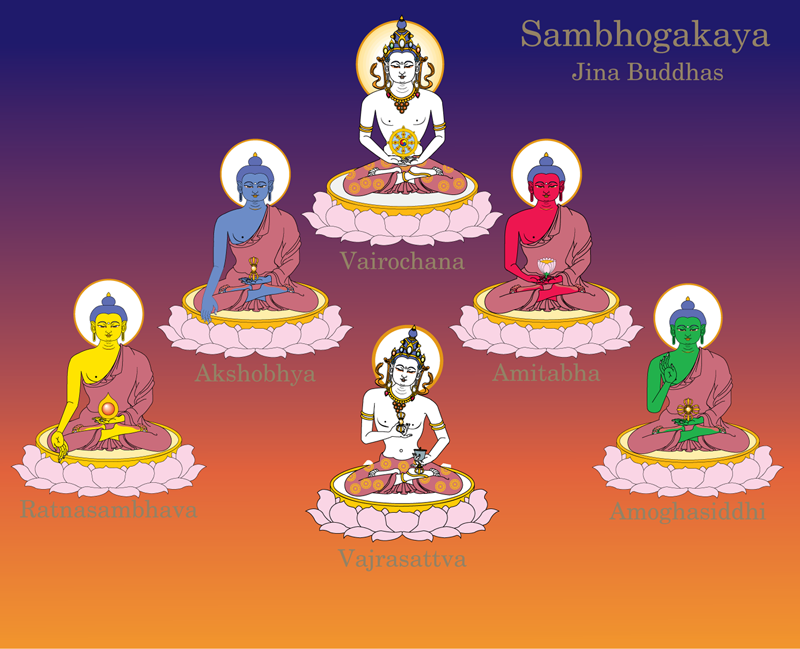

The Sambhogakayas of Five Dhyani Buddhas and Vajrasattva
Sambhogakaya (Tib: longs sku; Skrt: sambhogakaya)

The "enjoyment body" of the buddha. The sambhogakaya is a body made entirely of light. This form is often visualized in tantric and sutric practices and is characterized by symbolic ornaments and postures. In Dzogchen, the unadorned image of the dharmakaya is often visualized instead.


Samsara (Tib: 'khor ba; Skrt: samsara)

The realm of suffering that arises from the occluded, dualistic mind, where all entities are impermanent, lack inherent existence, and where all sentient beings are subject to suffering. Samsara includes the six realms of cyclic existence, but more broadly refers to the characteristic mode of existence of sentient beings who suffer through being trapped in the delusions of ignorance and duality. Samsara ends when a being attains full liberation from ignorance, nirvana.


Shenlha Okar (Tib: gShen Lha 'od dkar)

Shenlha Okar is the sambhogakaya form of Shenrab Miwoche, the buddha who founded Bon.


Shenrab Miwoche
Shenrab Miwoche (Tib: gShen rab mi bo che)

Shenrab Miwoche was the nirmanakaya Buddha that founded Bon, traditionally believed to have lived seventeen thousand years ago. There are fifteen volumes of biography of Shenrab Miwoche in the Bon literature.


The bhavacakra (Tibetan: srid pa'i 'khor lo) is a symbolic representation of samsara (or cyclic existence).
Six realms of cyclic existence  (Tib: rigs drug)

Commonly referred to as "the six realms" or "six lokas." The six realms refer to six classes of beings: gods, demi-gods, humans, animals, hungry-ghosts, and hell-beings. Beings in the six realms are subject to suffering. They are literal realms, in which beings take birth, and also broad experiential and affective bands of potential experience that shape and limit experience even in our current life.


Sutra (Tib: mdo; Skrt: sutra)

The sutras are texts composed of teachings that came directly from the historical Buddha. The teachings of sutra are based on the path of renunciation and form the base of monastic life.


Tantra (Tib: rgyud; Skrt: tantra)

Tantras are teachings of the Buddhas. They are based on the path of transformation and include practices such as working with the energy of the body, the transference of consciousness, dream and sleep yogas, and so on.  Certain classes of tantras may also contain teachings on dzogchen.


Tapihritsa
Tapihritsa (Tib: ta pi hri tsa)

Although considered an historical person, for Bon practitioners Tapihritsa is iconographically represented as a dharmakaya Buddha, naked and without ornaments, personifying absolute reality. He is one of the two principle masters in the dzogchen lineage of the Zhang Zhung Nyam Gyud.


Terma (Tib: gter)

In Tibetan culture there is a tradition of "terma"; sacred objects, texts or teachings hidden by the masters of one age for the benefit of the future age in which the termas are found. The masters who discover terma are known as "tertons," treasure finders. Terma has been and may be found in physical locations, such as caves or cemeteries; in elements such as water, wood, earth or space; or received in dreams, visionary experience, and found directly in deep levels of consciousness. The latter case is known as gong-ter: mind treasure.


Three root poisons

Ignorance, aversion, and desire, the three fundamental afflictions that perpetuate the continuity of life in the realms of suffering.


Tibetan letter "A" inside a thigle.
Tigle (Tib: thig le; Skrt: bindu)

Tigle has multiple meanings depending on context. Although usually translated as "drop" or "seminal point," in the context of the dream and sleep yogas the tigle refers to a luminous sphere of light representing a quality of consciousness and used as a focus in meditation practice.


Transmission (Tib: lung)

Often, a qualified lineage master will give transmission for a particular teaching by verbally reciting the Tibetan text of the teaching in the presence of the student. This recitation is typically done after detailed instructions have been given; for example, at the close of a retreat. By receiving the transmission, a student is empowered to study and practice the teachings on his or her own.


Tsa [see under "channels."]


Longchen Nyingtik
Yidam (Tib: yid dam; Skrt: devata)

The yidam is a tutelary or meditational deity embodying an aspect of enlightened mind. There are four categories of yidams: peaceful, increasing, powerful and wrathful. Yidams manifest in these different forms to overcome specific negative forces.


Yogi (Tib: rnal 'byor pa; Skrt: yogi)

A male practitioner of meditative yogas, such as the dream and sleep yogas.


Yogini (Tib: rnal 'byor ma; Skrt: yogini)

A female practitioner of meditative yoga.


Zhang Zhung Nyam Gyud (Tib: Zhang Zhung snyam rgyud)

The Zhang Zhung Nyam Gyud is one of the most important cycles of dzogchen teachings in Bon. It belongs to the upadesha (secret oral instruction) series of teachings.


Zhine (Tib: zhi gnas; Skrt: samatha)

"Calm abiding" or "tranquility." The practice of calm abiding uses focus on an external or internal object to develop concentration and mental stability. Calm abiding is a fundamental practice, the basis for the development of all other higher meditation practices, and necessary for both the dream and sleep yogas.


Shared by Lotuschef / Pure Karma / True Buddha School